Tuesday, June 28, 2011

EcoDharma launch the Sila Network

Last week Triratna News posted a story from Guhyapati outlining the EcoDharma Centre’s five-year vision and current opportunities.  They've just launched a new initiative, The Sila Network, and are looking for people to join them.  He explains -
“The Sila Network aims to help Buddhist Centres across Triratna bring the transformative power of the Dharma into effective relationship with society.  It also seeks to support the application of Buddhist ethics to the 21st century.  A number of Order Members, friends and mitras have been working together over the last year to create it”.  “Central to our thinking was a conviction that as students of the Dharma, and in a time of planetary crisis, it’s essential we engage with the social context in which we find ourselves,” explains Alex Swain, who is taking on an administrative role in the network. “In Triratna,” she continues, “we speak of this in terms of ‘transformation of self and world’, and this initiative seeks to help make that a reality.”
The Sila Network team, which includes Guhyapati from the EcoDharma Centre, Lokabandhu from the Triratna Development Team, and Ben Jackson who is currently based in Berlin, has drafted the following mission statement:

The Sila Network seeks to support institutions throughout the Triratna Community to exemplify ethical ideals, as applied to ecological sustainability and social justice issues. We want to help Buddhist Centres, businesses and communities to address ethical consumption, energy descent and radical simplicity, and to communicate about these choices in a way that inspires and encourages similar change in others. Applying Buddhist ethics to a 21st century context, we are seeking to support institutions within Triratna (including: Urban Buddhist Centres, Rural Retreat Centres, communities, Right-Livelihood initiatives and businesses) to embrace and exceed the best practice already evident in society at large. The network emphasises the “power of community” to address our shared ecological and social problems in the belief that, together, we can work towards a transition from non-sustainability and social injustice to a sustainable future and culture of compassion”.

“Dharma practitioners are aware that our ethical precepts need to be upheld consistently through all aspects of our lives,” says Lokabandhu. “It’s increasingly evident that the choices we make in how we consume, where we bank, who our energy supplier is, and so on, really do matter, especially when we stand together in bigger numbers.”  With this in mind the Sila Network team feel that the Triratna Community has great potential to set an inspiring example for a culture which is too often preoccupied with individualism and consumption. It aims to assist our Triratna Centres to become beacons of ethical practice contributing meaningful solutions. “We hope,” explains Guhyapati, “ to support our shared aspirations of compassion and concern for the world, so that the power of the Dharma can continue to transform society, helping our Centres and institutions become exemplars and sources of inspiration.”

How can you help?
The team have already written to Triratna Centres in the UK and mainland Europe (where the initiative will focus for the time being), looking for one or two people within each local sangha to become ‘Sila Network Contacts’.  They’re hoping to find,  within local Triratna Sanghas, people with expressed concerns about sustainability and other social issues who might be drawn to work with the Network. Or people in local Buddhist Centre teams who’re interested in the help the Network could offer. Some Centres are already doing excellent work in these areas. So, there may be someone in your local centre team already engaged in this kind of work, and if there is, the Sila Network team would love to speak to them!  They might also be able to help share their experience around the movement.

Can you recommend someone, or would you like to get involved?  If so, please put yourself or them in touch with us, through our email address silanetwork@ecodharma.com

There will also be a meeting in the EcoDharma space at the Buddhafield Festival in mid-July. If you’re planning to attend, look out for it on the program and come and meet the team there.

Labels: , ,

Monday, February 21, 2011

On-Line Buddhafield Dharma: part III

In the last of our three-part series featuring essays from the newly-released Buddhafield Dharma Series I, Triratna News brings you three more essays from Order Members in the Buddhafield Sangha.

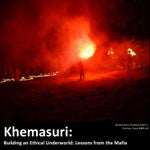
Khemasuri, in ‘Building an Ethical Underworld’, undertakes a fascinating exploration of the synergies between modern Systems Thinking and the Dharma, asking the question “how can we set up the conditions for change?” Provocatively subtitled, ‘Lessons from the Mafia’, she draws parallels between the Mafia and the Sangha: both originate outside the traditional institutions of civil
Society, and being ‘outside the box’ are not bound by convention or traditional values and behaviour - the difference being, of course, that the Sangha exists to promote what she calls an ‘ethical underworld’ rather than a criminal underworld!
(click here for the PDF version)

Kamalashila, in ‘Community, Nature, and Reality’, offers a set of guidelines for creating effective and satisfying community - which he defines as perhaps the most urgent and difficult challenge facing our individualistic, disconnected world. Significantly, this comes out of his eighteen-month solitary retreat in the Welsh hills, where he discovered that “being close to nature provides wings for my fledgling understanding of things”.
(click here for the PDF version)


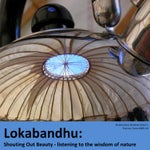
Finally, Lokabandhu, in ‘Shouting Out Beauty - listening to the Wisdom of Nature’, explores how the natural open-air settings of Buddhafield retreats provide the perfect - though challenging conditions to explore the Buddha’s classic teaching of the Noble Eightfold Path.
(click here for the PDF version)

Buddhafield Dharma Series I is a collection of on-line essays exploring Buddhafield’s approach to the Dharma and its application of the Dharma to the great issues of our time, both individual and collective.

Labels: , ,

Sunday, February 13, 2011

On-Line Buddhafield Dharma: part II

Last Sunday Triratna News began a three-part series featuring essays from the newly-released Buddhafield Dharma Series I, a collection of on-line essays exploring Buddhafield’s approach to the Dharma and its application of the Dharma to the great issues of our time, both individual and collective.

Our second instalment features three more essays -click any of the title links to read on-line with Issuu.

Myth, Poetry and the Goddess, by Dhiramati, is a passionate and evocative call to follow him and simply “give up, relax a little” - and thereby enter a very different realm. As he describes one of his early Buddhafield retreat experiences - “I lay down and looked up into the canopy of trees above me. The light was like brilliant silver shimmering and dancing between the leaves which were illuminated from within and glowing, all swaying in a gentle whisper as the wind breathed. It’s hard to describe but I knew Tara, I wasn’t thinking, but I sensed directly something there in that beautiful place. An unfolding, a presence, alive in nature, singing, calling, to everything, in everything, to me, to my body, my breath, my senses...”  (click here for the PDF version)

Akuppa , author of the much-loved ‘Shambala Warrior Mind-Training verses’ asks us to ‘Strive On’ and offers ‘Five ways to stay Sane and True and survive Global Meltdown’, drawn from the five ethical precepts of Buddhism. He asks us to keep a vision of humanity, give ourselves to community, avoid being implicated in systems that cause harm and division, speak out, and keep the broadest possible perspective - and promises that in doing those things, we survive, in the deepest, fullest sense of the word, and what is most precious about our humanity will not be lost.  (click here for the PDF version)

In 'The Living Elements’ Kamalashila sets out his thesis that seeing what really happens in experience will enable anyone to liberate themselves from ever-present, deeply held assumptions – views that are false and undermining - and that if we could connect much more fully with the basic elements of life, we would more easily cut through the accumulated cobweb of our complex delusion. (click here for the PDF version)

Enjoy!  And look out for Part III (and last) next Sunday...

Labels: , ,

Monday, September 27, 2010

Karuna celebrates 30 years of compassion in action

Karuna is like a bridge.
The beneficiaries are that side of the river,
and we are on this side.
Previously we couldn’t reach them.
But now, because of Karuna, we can help
.”
Karunaprabha
Triratna's Karuna Trust is celebrating its 30th anniversary with a special Newsletter.  Karuna was formed in 1980, in response to the suffering of India’s Dalit population. In the 30 years since that time, Karuna has sent over £16,000,000 in funds to India and south Asia. The majority of these funds have been raised by 400 Triratna volunteer fundraisers who have given their time to do a Karuna Appeal.

Of the £1.8 million that we raised in 2009, £1.4 million, or 80% came from nearly 8,000 individual regular donors who have been recruited one-by-one on the doorstep by Triratna volunteers over the past 30 years.

Karuna’s fundraising, and therefore its vital social and Dharma work, is almost entirely dependent upon volunteer fundraisers from the Triratna Buddhist Community.

Vajrapushpa, Chair of Karuna Trustees, says -
The 2010 Karuna newsletter (sent to 8000 Karuna supporters) celebrates Karuna’s 30th anniversary. The personal experiences described inside it's covers illustrate some of the reasons why Karuna has been so successful over the past 30 years in helping to transform the lives of thousands of people in south Asia.

The three people interviewed in the newsletter come from some of the poorest communities in India. Having struggled against the odds to fulfill their own dreams, they’re now dedicating their lives to helping others. For them, this commitment is not an interesting career choice; it is an integral part of how they see the world and their place in it. Karuna is fortunate to be able to work with such dedicated people.


To all those in the Triratna Buddhist community - past and present - who have supported Karuna and our work in south Asia, please accept our heartfelt thanks.

get involved
If you feel strongly about helping India’s Dalit community to escape the hell of caste, then please do consider giving some of your time in 2011 to fundraise for Karuna, or encourage your friends to do so. In 2011, we will be running door-to-door appeals, telephone fundraising campaigns and a new one-year-long men’s fundraising community. We offer full training and financial support.

To see a full version of the Karuna 2010 newsletter and the personal stories of Karunaprabha, Maitreyanath and Yashosagar please visit www.karuna.org

To enquire about helping out on a Karuna fundraising appeal in 2011 contact us on 0207 700 3434 or email appeals@karuna.org

Labels: , , ,

Tuesday, September 21, 2010

EcoDharma Centre launches ‘Nature-Based Practice’ Series of retreats

Eagles soar on the cliffs above EcoDharma
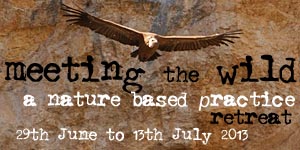
 The task of translating the Dharma into the world of the 21st century is crucial to the practice of Western Buddhism. One Triratna retreat centre engaging whole-heartedly in this creative process is the EcoDharma Centre in the Catalan Pyrenees. Their latest initiative is the new ‘Nature Based Practice Series’, which take meditation retreats into the heart of wild nature.

“Perhaps the defining feature of this moment in history is the need for civilization to change course from its destructive path of industrial growth and consumption,” says centre director Guhyapati. “Contemporary Buddhism,” he continues, “is by definition Buddhism amidst ecological crisis. Buddhism has much to offer in facing that crisis, but to be truly relevant today Buddhism needs to take its potential role very seriously.” In their attempt to step up to this challenge, the EcoDharma Centre team has been addressing important questions - how their practice of meditation and Dharma can really support the development of an ecological sensibility and contribute towards a life-affirming future; what relevance ecological issues have to the practice of Dharma today; and more.

solar panels at EcoDharma
Their answers range from attempts to embed the Centre and community in sustainable ways of living which draw out the ecological implications of Buddhist ethics, to exploring the theoretical interface between the Dharma and ecology.

The “Nature Based Practice” series, which is launched this autumn, is another outcome of this exploration. This consists of a series of retreats, crafted by the EcoDharma team, which bring Dharma and meditation together with the transformative power of wilderness immersion. “Living as we often do today, entirely enveloped in the urban environment, it is easy to find ourselves cut off from our deeper nature,” points out Rob, one of the team involved in putting on the events. He explains that “these events support people to take their meditation practice out into wild nature, helping to heal alienating splits both in themselves and between themselves and the natural world we depend on.” The landscape around the centre is both awesome and intimate, and the team has spent many years getting to know it well. “For me,” adds Rob, “just wandering, living and meditating in these woods, meadows and caves is a deeply empowering and transformative experience.”

Contact with nature is being increasingly recognized as a key to opening people up to the importance of ecological concerns and empowering them to act to resolve the issues we face. But how does that tie in with dharma practice? “The foundational steps of Dharma practice are found in the process of healthy psychological integration,” explains Guhyapati. “The growing discipline of ecopsychology helps us see how crucial our connection with nature is in order to be healthy humans – especially living in such alienating times. ‘Nature Based Practice’ is a valuable tool in this process of integration. But it goes further than that. As we practice amidst the wild we begin to feel our embeddedness within nature in tangible ways. We begin to appreciate the profound interconnections which weave us into the rich web of life. Such insights and broadening of identity are core to the practice of Dharma.”

The team suggests that it is no coincidence that great yogis and sages have from time immemorial taken themselves off into the wilds to deepen their practice. “Taking mindful appreciation and meditation practice out into the wilds is a powerful and tested approach,” says Rob. The events in the series explore various ways to support people to test that out.

The first event in the series is “Meeting the Wild”, which runs in November. For more details of the events in the series or background to the “Nature Based Practice” approach, you can look at the centre´s website www.ecodharma.com.
Panorama showing EcoDharma in the distance - the small dot in the centre!

Labels: , , ,

Monday, August 23, 2010

Karuna Mexico acts in response to flood and hurricane

Members of Triratna’s Mexican sangha have been battling floods this month, as heavy rains and hurricanes have battered the country.

They write to say -

“This month the North of Mexico has gone through a heavy rain season and a Hurricane called "Alex", this meant many of Mexico’s poorest communities were flooded, as a consequence of living adjacent to rivers and dams which could not cope. Mexican news spoke of over 200,000 affected people, many of whom lost their homes, furnishings, and possessions.

“The photographs talk by themselves.

“Through the "Colecta Karuna" project of Mexico City Buddhist Centre, we invited people to help donating some non-perishable food, water, medicines, etc. Thanks to the support and generosity of people, we were able to gather a good amount of donations that will be useful at this time.

“We also organized an afternoon of meditation in benefit of this cause, doing meditations each hour from 2 pm to 6 pm. We closed the day with a puja dedicated to the victims, with our best wishes and positive feeling for the early resettlement and the arrival of aid.

“This puja was dedicated to Avalokitesvara in order to get in touch with the feeling of compassion to develop and expand, so our Buddhist practice was dedicated to people who are suffering at this time

“We would like to extend the invitation to that we can devote meditations and pujas in various centers of the Order to persons who suffer for whatever reason in the world.

"We end by saying - "Sabbe Satta Sukhi Hontu - May all beings be well, that all beings may be at peace, that all beings be free from suffering”

For more details of Colecta Karuna's work check their website www.karuna.mx

Labels: , ,

Saturday, July 10, 2010

Street meditation in Cambridge, UK

Ivan Trujillo writes from Triratna's Cambridge Buddhsit Centre with news of a new project - street meditation.  He asks - and answers - the question "Why meditate on the street?", saying -

"In Buddhism some meditations emphasize the cultivation of awareness of our senses, feelings and thoughts. The aim of the meditation is to transform positively the way in which we relate with the world and ourselves. And simultaneously to have a positive influence in our environment.

"Meditation practices are commonly related with being peaceful and relaxed, usually in very quiet and aesthetically appealing places.

"However, meditation cannot or should not be limited to perfect arranged places and situations. If we want to include the effect of meditation in our world and society, we need to bring the meditation into our world and society".

He goes on to give news of their next venture - today!

"This Saturday 10th of July, we will go to the Cambridge city centre to meditate.  You're invited to join us and share this experience with us. We are meeting at the Buddhist centre at 9:30 to tune in and we plan to start to meditate at 10 somewhere.

"For more information check the Event on Facebook: www.facebook.com/event.php?eid=128201607215201

Labels: ,

Friday, March 12, 2010

Opportunities coming up at Karuna

Andrea writes from the FWBO’s Karuna Trust with news of their hostel in Central India - and an invitation for 2 people to contribute to Karuna's work in London, starting next month. She says -

“The education of a child can pull a whole family out of the cycle of deprivation.  To illustrate this I'd like to tell you a little of Vidyha Salgare's story.

At an educational hostel in Latur, a small town in the heart of India, 65 girls from low-caste backgrounds have found love, support and the opportunity to build a future.

The Latur Girls Hostel is a special place. A delightful family atmosphere is created by 65 girls and three wardens with a mix of exuberance, intelligence and care. The walls resound with creativity and potential. The Karuna supported hostel was purpose built after a devastating earthquake in 1993 in a drought-prone area of Maharashtra.

Vidhya Salgare is from a Dalit family. “I was 10 when my father was murdered. There was discrimination against Dalits in the office where he worked. They found acid in his ears. My mother sells vegetables now, a very hard life. My father loved me, and wanted me to get an education. In the village, the teacher made me sit at the back of the class. It’s not like that here in Latur. I am very happy here.”

Admission to the hostel is based on need – the girls, such as Vidyha, come from the very bottom of the caste system. They live at the hostel free of charge, attend the local schools, and are coached by the hostel wardens.

The hostel, run by members of TBMSG (the Indian equivalent of the FWBO), is a wonderful example of how the rigid hostility of caste can be transformed by care and friendship, and girls who were once imprisoned by poverty and discrimination can realize their potential, and in turn, gain dignity, strength, and hope for the future.

Calling YOU!
Could you tell a story like Vidyha’s to a Karuna supporter? Join a Karuna Phone Campaign from 19 April to 28 May 2010 and find out!

Karuna supporters are often pleased to hear more about our work in Asia, especially when they hear what a difference their donation is making to lives like Vidyha’s. As such, a supporter is often inspired and moved to increase their existing donation.

We need to find 2 more phone fundraisers to join a team of fundraisers for a Karuna phone campaign. It will be 6-weeks long, non-residential, working with a team of Buddhist men and women out of the Karuna office in North London. Financial support is offered.

During the campaign we'll be phoning existing Karuna supporters to communicate the benefits of Karuna’s work in South Asia with a view to them increasing their existing donation.

A fundraiser on a 6-week Karuna phone campaign could raise an extra £17,000 for Karuna. That’s the equivalent of keeping Vidhya and at least 10 of her friends at the hostel for 5 years – enough for them to receive a decent education.

If you would like to tell a story like Vidhya’s, please contact Jo Goldsmid on 0207 697 3006 or jo@karuna.org

Labels: , , ,

Saturday, February 13, 2010

introducing Karunamati and the Green Tara Trust

Today’s ‘FWBO People’ profile is of Karunamati, a UK Order Member and medical doctor, who’s worked for many years in Nepal, as founder and director of the Green Tara Trust.

Here’s what she says about her work -

“I have been working in Nepal for 15 years now and it is my second home. Nepal is a vibrant country where the people are very welcoming. The terrain is very tough, with poor communication routes due to the Himalayas; most people to the north of Kathmandu are nowhere near a motorable road so access is on foot.

“There has been a civil war in Nepal for a few years now; although there is now an “elected” government (the Maoists) the law and order is still poor. As a tourist it is fine to visit but for us on the ground, our work is hard due to fuel strikes and road blocks. This can hold us up considerably but we work around this, sometimes by working at night! The war has also seen huge internal migration, with a ten- fold increase in sexually transmitted infections, an increase in sexual violence towards women and the destruction of health facilities.

“Our charity works in the field trying to improve lives of the poorest people through direct action. However, in order to be more effective we also work at national level with the Government. For example, we are assisting them in re-writing the national curriculum for all Nepali health staff in preventative health measures and health communication as they currently have none. Our techniques and experience in the field inform this process. In this way we are able to improve many more lives through the health system.

OUR PROGRAMMES
1. Preventing maternal and child deaths through health promotion. Specifically we:
* Work in groups to ENCOURAGE POSITIVE BEHAVIOURS: particularly with husbands and mother in laws who control women’s access to good nutrition and medical care.
* BUILD CAPACITY in the community, particularly women’s ability to save money for their delivery, make choices and help them have a voice in society.
* IMPROVE THE MEDICAL CARE THAT IS ALREADY AVAILABLE so Government workers can deliver a World Health Organisation standard antenatal appointment.
We are into the second year of the programme now; we have many active groups and over 50 project volunteers.

2. National Lesbian Society- Mitini Nepal
We work with Mitini to provide education, counselling, support and direct legal action where human right violations have occurred as a result of discrimination. The photos shows Mitini supporters at a peaceful demonstration in Kathmandu.

“The Green Tara Trust has a new website at http://www.greentaratrust.com.

Labels: ,

Wednesday, February 03, 2010

Karuna and ClearVision collaborate to promote awareness of Buddhist-led development work and social action in Asia

Maitrisara, a member of the Western Buddhist Order based in Oxford, UK, writes with news of a major survey of UK Buddhists’ interest in and knowledge about Buddhist-inspired and Buddhist-led development work and social action in Asia.

The initiative came from a shared realisation that although there is a great deal of such work, spread across Asia and involving many different Buddhist Sanghas, much of it is hardly known about.

She says -

“A recent online survey completed by 295 Buddhists (77% from the FWBO!) aimed to find out more about UK Buddhists' interest in and knowledge about Buddhist-inspired and Buddhist-led development work and social action in Asia; also to find out how they understood the relationship between personal and social transformation.

“To see a summary of the results, and respondents’ reflections on the question "Personal and social transformation are indivisible - do you agree?” – click here. The reflections especially are extremely interesting!

“The outcome of this process is that a project application has been submitted to the UK Government’s Department for International Development (DFID) by Karuna www.karuna.org in partnership with Clear Vision www.clear-vision.org.

“Original study materials will be created including video footage of projects in the global South. This will be accessed on an online learning hub. There will also be exchange and networking spaces such as inter-group meetings, retreats and conferences. We wait to see if the application has been successful.

“We would like to thank all those who contributed to the survey. We were impressed with the responses, both in the thought given to them and the number completed in such a short time. The information will have value beyond this project as we think it's the biggest survey ever completed on Engaged Buddhism and certainly the most current”.

Maitrisara (Oxford, UK)

Labels: , ,

Thursday, January 21, 2010

Karuna Mexico acts in response to Haiti emergency

Upeksamati, chairman of the FWBO’s Mexico City Buddhist Centre, writes with news of Mexican Buddhists response to the recent tragic earthquake in Haiti. He says -

“Haiti needs help. And Karuna Mexico, along with other Mexican Buddhist Centres, are responding.


“After a quick appeal by Karuna Mexico a lot of people delivered all sort of goods to them: bottled water, medicines and foods.

“Two days later, the Mexico City Buddhist Centre van went twice fully loaded to the Cruz Roja (the Red Cross) to deliver what they had collected. The MCBC van had to queue for 15 minutes before it could enter the plaza where donations were being received. There we found hundreds of volunteers, from all quarters, hard at work. When the van arrived it was surrounded by 5 Boy Scouts who took no longer than 7 minutes to unload the van carefully and effectively. After we were gone our space was taken by yet a different car delivering.

“At the moment we are in the second phase of the appeal gathering more things. The boxes at the reception of our Buddhist centres are quickly filling up again.

“In this moment there is no difference between people, nations, or anything. Here is where we experience the true meaning of "Karuna": a force that drives us to help without expecting anything in return.

“That is why the people of Mexico in general, and the Buddhists at our Centres, are creating support networks to reach as soon as possible the people of Haiti and to ease the suffering and problems that have arisen.

“This assistance has been channelled to the Cruz Roja from Mexico who are in charge of sending the appeals to Haiti. The Collection at the Buddhist centres will continue a few weeks, We hope residents in Haiti will get better.

“Sabbe Satta Sukhi Hontu - May All Beings be Well

Karuna Appeal Mexico www.karuna.mx

Labels: ,

Thursday, January 07, 2010

An invitation - and a challenge - from the Karuna Trust fundraising team

Khemajala, a fundraiser at the Karuna Trust, writes with an invitation - and a challenge - for all men reading FWBO News. He says -

"Would you like to live a truly meaningful and memorable year as part of a Karuna Men's Fundraising Community?

"On 29 September 2006, in Khairlanji village, central India, Surekha Bhotmange, her daughter Priyanka and her two sons, Roshan and Sudhir were dragged from their home by a mob, stripped naked, paraded through their village, beaten to death, and their bodied dumped in a nearby canal.

 Bhaiyyalal Bhotmange, the father of the family (photo opposite), escaped by lucky chance. The details of this caste-based crime are sickening, and the hatred behind it is difficult to comprehend but the viciousness is typical of many crimes committed against lower caste people in India every day.

"Most of these crimes are invisible, but this atrocity came to light through Dalit campaigns and became an international news story. The Manuski project, led by members of TBMSG (the Indian equivalent of the FWBO), and supported by Karuna, played an important part in making that happen.

"Could you tell Bhaiyyalal’s story? You could give Dalit people such as Bhaiyyalal a voice and help them escape the suffering caused by caste discrimination.

"How? Live a truly meaningful and memorable year as part of a Karuna Men’s Fundraising Community

"From September 2010 to August 2011, Karuna will be pioneering the first team of Karuna Appeal fundraisers who will come together for a year to live and work together as a community of fundraisers.

"We need a team of four or more men.

"What we’re offering:

• Community living based in London
• Blocks of 6 weeks fundraising followed by at least one week off
• A total of 10 weeks leaves including a trip to India and time for retreats
• Training in Fundraising as a spiritual practice
• A comprehensive support package
• Led by Jayaraja

"For more information -
Contact Khemajala
Phone 0207 697 3004
Email khemajala@karuna.org
Web www.appeals.karuna.org

Labels: , , ,

Wednesday, January 06, 2010

Opportunity at EcoDharma in Spain

Maitrisara writes with news of an opportunity for anyone over50 looking for a stay in the Pyrenees this autumn. She says -

“Grant funding enables us to offer 6 expenses paid places on a volunteering project at the EcoDharma centre between 1 and 2 months in September and October 2010. (www.ecodharma.com)

"EcoDharma is a Buddhist based community living in a remote valley in the Catalan Pyrenees. The wild beauty is incredible as are the ideas talked about over supper! The influences on the centre’s philosophy include radical ecology, The Work that Reconnects, engaged Buddhism, systems theory and holistic experiential learning.

“You need to be over 50 (yes we know that’s a bit strange but that is what the funding is for!) and reasonably fit. Living as part of the community, you will be involved in the garden and building projects. If you know a bit about permaculture, building or capentry, food preserving - this might particularly suit you. Get in touch with Maitrisara - maitrisara@tiscali.co.uk if you want to know more about it and are interested.

“Please pass on to anyone you think would be interested (in the right age bracket!!)

With warm wishes
Maitrisara


The retreat centre is just visible as the tiny white dot on the plateau in the centre-left of the photograph.

Labels: , ,

Thursday, December 24, 2009

A Buddhist reports from Copenhagen

Today’s post is from Yogaratna, an Order Member and environmentalist from Cambridge UK, recently returned from the climate change conference in Copenhagen. We’re hoping to bring further reports later in the week from the FWBO’s EcoDharma centre in Spain, many of whose community also attended.

Yogaratna writes -
“From London it was £485 by rail, and about £18 to fly. Luckily I have the money, and I like train journeys.

“A blue sky, a big main square stuffed with thousands of people, clever banners, funny costumes, performances, dance music: a party atmosphere. I met up with some Gaia House Buddhists, and marched with their banner, which said: “what we do to the planet we do to ourselves”.

“I found it moving to be around thousands of people, all passionately wanting a positive response to climate change. A few hours later there were some angry speeches, lots of police started blocking off streets where I was; and I ran away to get my train home.

“Many people (including myself) think nowadays that it seems unlikely that we can avoid runaway climate change. So why did I bother doing 44 hours of train travel, to be in Copenhagen for 8 hours? And what has all this frankly very political stuff got to do with Buddhism?

non-harming, and not taking the not-given
“For me it comes down to the first 2 precepts. Non-harming; but in particular not taking the not-given. I think it is in principle unethical to deprive any human of the basic necessities of life, especially in terms of food, water and shelter - but also education and healthcare. Ethically speaking, I don't think that we in the West have a right to our higher standard of living, which depends on a greater share of the world's natural resources. Our relative wealth (in global terms) depends on economic and military power, not metta or wisdom.

“It's increasingly obvious that the world's resources are very limited, that we rich are maintaining our lifestyle at the expense of the poor - and that climate change will make this dynamic much worse. Reading about the Copenhagen climate negotiations, I'm struck by the extent to which the wealthy countries have given up humanist posturing, and got down to power politics. The rich countries seem to be saying to the developing countries: we accept that we are on course for runaway climate change (which was caused mainly by ourselves), we are prepared to do almost nothing to reduce our greenhouse gas emissions, we believe you will die in very large numbers; here's a bit of money.

a time of great reality - and great surreality
“Copenhagen seems to have been a time of great reality, to the extent that people from all over the world did meet each other and talk on this issue, even (perhaps especially) at complete cross-purposes. But also a time of great surreality. The policing mirrored the talks, targeting official delegations inside the conference centre as well as demonstrators outside. At the same time, I would guess the politicians themselves are probably more genuinely concerned about (and knowledgeable about) climate change than the general public. They know that Copenhagen was probably the best chance of avoiding runaway climate change, and they don't dare to support measures which the science demands, but which would be unpopular.

Hopenhagen - or a corporate-sponsored narcotic?


“And in the streets of Copenhagen, the Hopenhagen posters. An advertising campaign instigated by the United Nations, essentially a positive idea (build hope for the Copenhagen conference) - but what about the corporate sponsors? One of them is Coca-Cola; a role model for doing virtually nothing on climate change. So the real message of Hopenhagen advertising is narcotic: we're nice people because we hope, it's OK to carry on sleeping and doing nothing; have a coke.

what would the Buddha say?
“So how about Buddhism? What would the Buddha say about all this? I'd love to know. I can't help thinking that he'd be surprised at the lifestyles and carbon footprints of most of his Western followers. Surely we'd seem incredibly wasteful and materialistic to him - and selfish too? Or would he say: don't bother your head with global politics, the best thing you can do is get on with your meditation and teaching at local level.

“I like to think that if the Buddha were alive today he would be concerned about global politics, because of their effect on human suffering - and even that maybe he'd be a figure somewhat like Dr Ambedkar. Of course, in his own lifetime, the Buddha talked to everyone; to beggars, but also to kings and their ministers. Arguably, the Buddha was very influential and probably wanted to be, both socially and politically.
“Of course, I'm neither the Buddha nor Dr Ambedkar; I'm just a pebble on the beach. But I want to live ethically; which is why I work to reduce my personal carbon footprint, and give some time to promoting awareness of this issue. Maybe we tend to underestimate the consequences of our actions. I think, or maybe feel, that our actions spread a long way into the future. Particularly at a time when so little is being done, every action against climate change now might be surprisingly and materially important to people in the future”.


“Overall, Copenhagen seems to me very poignant. It's as if the West would love to persuade itself that it does care, but knows it doesn't really. Like an alcoholic who thinks he should give up, but knows he won't. But even that's just one part of the story: personally I came home feeling very inspired by the people I'd met. And each year the anti-climate change movement is growing, all over the world. Within the FWBO there is much excellent work being done towards a more sustainable world; the EcoDharma retreat centre and living situation in Spain particularly stands out for me.


Yogaratna, December 2009

Labels: ,

Wednesday, December 16, 2009

International Network of Engaged Buddhists (INEB) celebrates 20th anniversary


The International Network of Engaged Buddhists (INEB) recently celebrated its 20th anniversary at Chiang Mai, Thailand, in the course of which Lokamitra led a retreat for over 100 participants from all over the Buddhist world. Priyadarshi Telang, from TBMSG's Jambudvipa project, sends us his report. He says -

"The International Network of Engaged Buddhists (INEB) celebrated its 20th anniversary November 9th-17th at the at Chiang Mai, Thailand, November 9th-16th with a variety of activities. Over the last few years links with INEB have grown; Lokamitra is at present a member of their advisory committee, while Mangesh Dahiwale is a member of their executive committee. INEB was founded by Sulak Sivaraksa, who at the age of 76, is beginning to withdraw from the front line of INEB activities.

"The conference therefore also marked this period of transition with the formation of larger and more diverse advisory and executive committees, as well as a secretariat more able to coordinate the fast growing network.

Sangha and Kalyanamitra

"The celebrations started with a three day retreat led by Dhammachari Lokamitra. This was attended by about 100 participants from 16 different countries. The participants included almost 30 bhikshus and bhikshunis from Sri Lanka, Thailand, Laos, Ladakh, and Bhutan. Indian participants included Maitrivir Nagarjuna from the New Delhi centre, Pradeep Bansode, Priyadarshi Telang and Mangesh Dahiwale from Jambudvipa Trust, Deepak and Manish from Nagarjuna Training Institute, Anand Shakya from Karuna Vihar Hostel, Gujarat, and Anurag Meshram and Sumedh Sthool, social activists connected with The Jambudvipa Trust. Ratnadharini, from Tiratanaloka, UK, also attended.

"The idea of the retreat was to provide a situation in which people could experience deeper communication on the basis of going for refuge to Buddha, Dhamma and Sangha, as a prelude to the four days of discussions that followed. The theme was “Sangha and Kalyanamitra”. INEB is trying to operate according to the principles of Sangha, while Sulak Sivaraksa has always emphasised that it is the spirit of kalyanamitrata that breathes life into the network. On the first day Jonathan Watts, Jill Jameson and Ven Kalupahana explored the question of Sangha in the modern world. On the second day, Ven Khenpo, and Tempel looked at the principle of Kalyanamitra. On the last day, Anchalee Kurutach, Dhammacharini Ratnadharini and Harsha Navaratne talked about work as spiritual practice from their own experience.

"Given the diverse traditions which the retreatants came from, Lokamitra tried to make it as inclusive as possible. Apart from the short talks and discussion groups following them, the day consisted of a number of periods of meditation, including special emphasis on the metta bhavana. The days started with traditional salutations from Theravada and Mahayana monks and nuns, as well as from the Japanese “priests”. It concluded with the Seven Fold Puja, or the Pali Puja led by Indian friends.

"The retreat was followed by the 3-day conference, the mornings of which included four sessions of talks and symposia, while the afternoon sessions were meant for group discussions based on country and general issues. On the first day Mangesh Dahiwale made a presentation on “Critical reflections on Engaged Buddhism” with Jonathan Watts. On the third Ratnadharini gave a presentation on the future of the Sangha, along with the Thai bhikshu, Ven Phaisan, who preceded her, and in calling for a thorough review of approach to Sangha, paved the way for her by indicating that more serious attention needs to be given to the approach the Western Buddhist Order. Ratnadharini approached the question by looking at her work and life as a preceptor based at Tiratanaloka, the women’s retreat centre in UK dedicated to helping women prepare for ordination. Later in the morning Lokamitra led a discussion on “Coming Home – the implications of the Revival of Buddhism in India” in which Dhammachari Viradhamma, Dhammachari Maitriveer Nagarjuna and Dr. H.C. Yo participated. The last day was taken up with a meeting of the advisory and executive bodies. The whole programme was interspersed with other talks and cultural events, some of them spontaneous.

"Most of us felt, at the end of the retreat and conference, that we had been able to communicate something of the enormous significance of Dr. Babasaheb Ambedkar’s conversion to Buddhism, as well as of the relevance of the approach of the FWBO/TBMSG in the modern world.

"But we all went away inspired by the efforts of so many Buddhists to put apply their practice of Buddhism to the social issues confronting the modern world, by their receptivity, friendliness, and by the trans-cultural situation we found ourselves in.

"It is a great tribute Sulak Sivaraksa that he has been able to cultivate this network of very dedicated but diverse number of Buddhists. INEB has grown considerably in the last 20 years and hopefully will have an increasingly positive influence on the world over the next few years".

Labels: , , , , ,

Wednesday, December 02, 2009

Ambedkar in Hungary - a report from India

Pardeep Jade, a journalist and blogger from TBMSG in India, writes with news of his recent fact-finding mission to the new Ambedkarite Buddhists of the Roma community in Hungary. His article has been published in The Hindu, one of India’s largest English-medium newspapers, plus Countercurrents, a major on-line alternative media site.

He tells the story of how he came into contact with two Roma leaders, Derdák Tibor and Orsós János, as they were discovering Buddhism and the inspiring example of Dr. Ambedkar, India’s great Buddhist leader - and how this led to his own visit to Hungary this Autumn. And how he discovered during his visit the deep parallels between the prejudice experienced over centuries by the Dalits, or Untouchables, of India, and the Roma, or Gypsies, of Europe.

He writes - “Jai Bhim, Namo Buddhay!  “Please read my article on "Ambedkar in Hungary" in The Hindu newspaper at www.hindu.com/mag/2009/11/22.

We quote an excerpt -

“After discovering Ambedkar, Tibor and János visited Maharashtra in 2005 and 2007. They felt a deep connection with the Dalits of India and with Dr. Ambedkar's emancipatory agenda. After returning to Hungary, in 2007, they founded the Jai Bhim Network, embraced Buddhism and opened three high schools named after Dr. Ambedkar in Sajókaza, Ózd and Hegymeg for Roma children. One of the activities of the Network is to invite young Dalit activists to Hungary and provide them with opportunities to interact with the Roma community. Recently, I was part of one such three-member delegation and lived with the Roma community in the village Sajókaza for almost a month…

Read more on The Hindu newspaper website or in Countercurrents.

You can contact Pardeep on pardeep.jade@gmail.com.

Labels: , , ,

Tuesday, November 24, 2009

On-line survey - your help please!

Maitrisara writes from Oxford with a reqeust for all FWBO News readers -

"The FWBO's Karuna Trust and Clear Vision are working together to develop a project
about Buddhist-inspired social action in Asia (eg Tibet, India, Cambodia,
Sri Lanka)

"The idea of the project is to support Buddhists in the UK to explore their
own practice in terms of the relationship between personal and social
transformation. Part of it will involve the development of online video
clips and study materials available through the Clear Vision website.

"It would help us if you would complete this survey - it only takes FIVE
MINUTES at most. Your answers will help us to design the project and give
evidence for any interest in what we are proposing to do. You don't have to
BE interested in the idea to do the survey - its all useful information to us.

www.surveymonkey.com/s.aspx?sm=IhDzMWjc_2b0RirTpSJOBWlQ_3d_3d


"NOTE: The deadline is 24th November. This is because of the deadline of the fund we are applying for.

"Thanks!"

Labels:

Friday, November 06, 2009

Windhorse Publications launch new book series 'A Buddhist View'

Sarah Ryan from the FWBO’s publishing house ‘Windhorse Publications’ (www.windhorsepublications.com) writes -

“I’ve got some news from WP for you!

“First of all, the first three books in our new series ‘A Buddhist View’ are now available – we’re really thrilled with how they’ve turned out. They are -

Meaning in Life by Sarvananda
Saving the Earth by Akuppa and
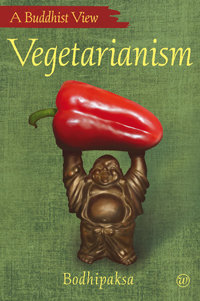
Vegetarianism by Bodhipaksa.

This brand new series from Windhorse Publications examines key issues in life from a Buddhist perspective, offering practical points on living in the 21st Century. The three books available so far deal with our relationships with the environment, food and our perception of life.

There’s various book launches going on - Sarvananda has been to the Cambridge and Ipswich Buddhist Centres.

Less conventionally Bodhipaksa is going to be launching Vegetarianism online on Friday 13th with a marathon 12-hour drop in discussion on his blog , Twitter and Facebook. We’re hoping FWBO News readers will drop in - I’ll write again with more details nearer the time.

Thank you very much for all of your help,
Best wishes,
Sarah Ryan
Windhorse Publications Ltd
t: 01223 911997

Labels: ,

Tuesday, October 13, 2009

Jambudvipa reports on hard-hitting anti-caste work


Many readers of FWBO News will be aware that at the twelfth session of its Human Rights Council, the UN moved to declare discrimination based on the Indian caste system to be a human rights abuse.

TBMSG - as the FWBO is known in India - is a grass-roots Buddhist community which has been working for 30 years to spread the ‘Dhamma Revolution’ in India.  Creating a caste-free society open to all Indians has long been central to their vision, and besides their long-running Dhamma teaching and extensive social projects they have more recently moved into advocacy work. The Jambudvipa Trust, based in Pune, is their most active ‘advocacy’ project; their work is an inspiration.

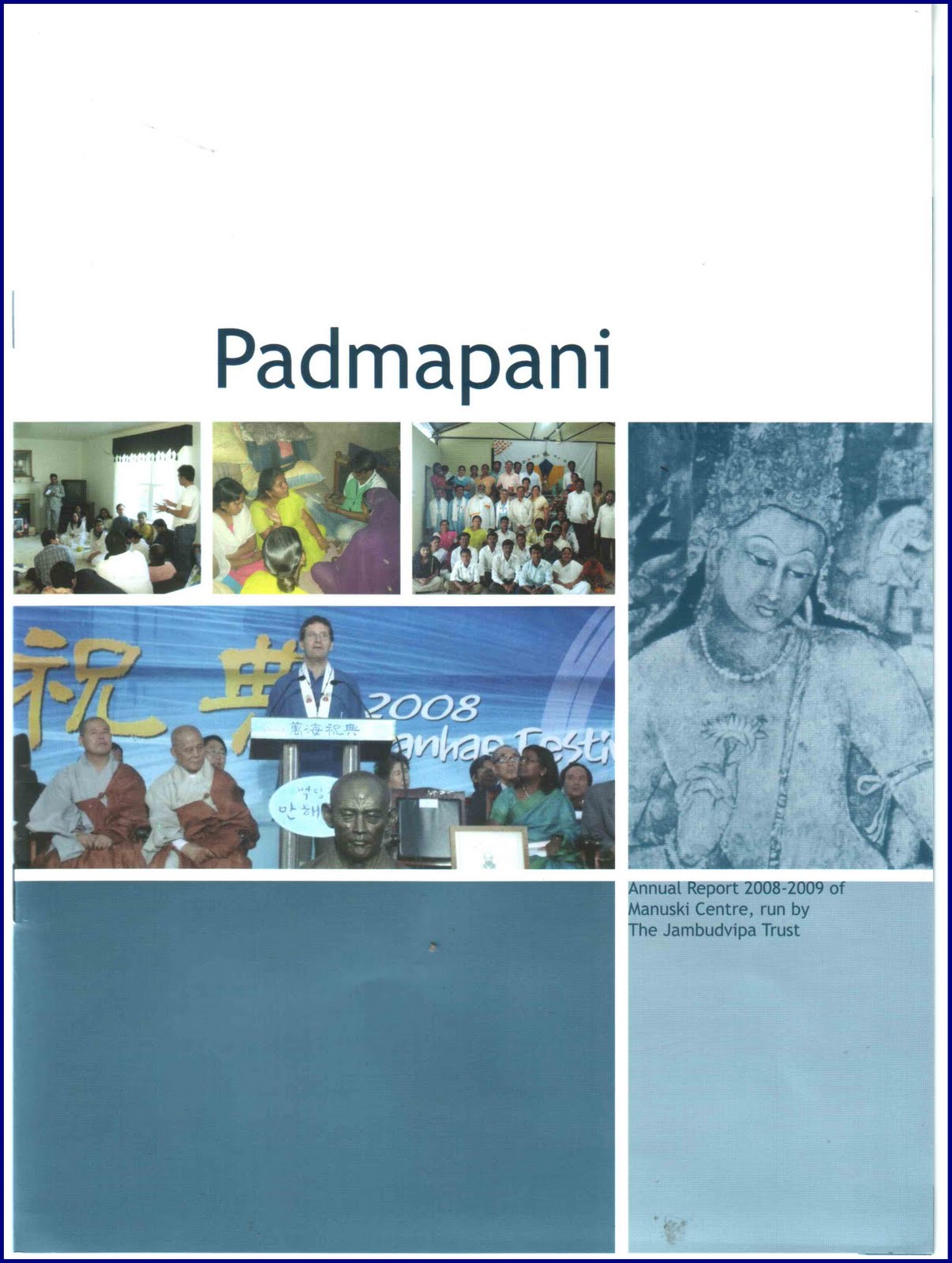
We’re proud to reproduce here this editorial from ‘Padmapani’, Jambudvipa's annual report and magazine.

Lokamitra, their president, writes -

“The Jambudvipa Trust, under its Manuski project is at present targeting five of the most disadvantaged communities in Maharashtra. One of these, the Paradhi community, along with other similar communities, has been cruelly dismissed and marginalised by being termed a Criminal Tribe. The result is that as well as having to live in unimaginably appalling conditions, they are subjected to arbitrary killings by the police and administration. Jambudvipa is working with such communities to make known their plight and help them develop their own leadership.

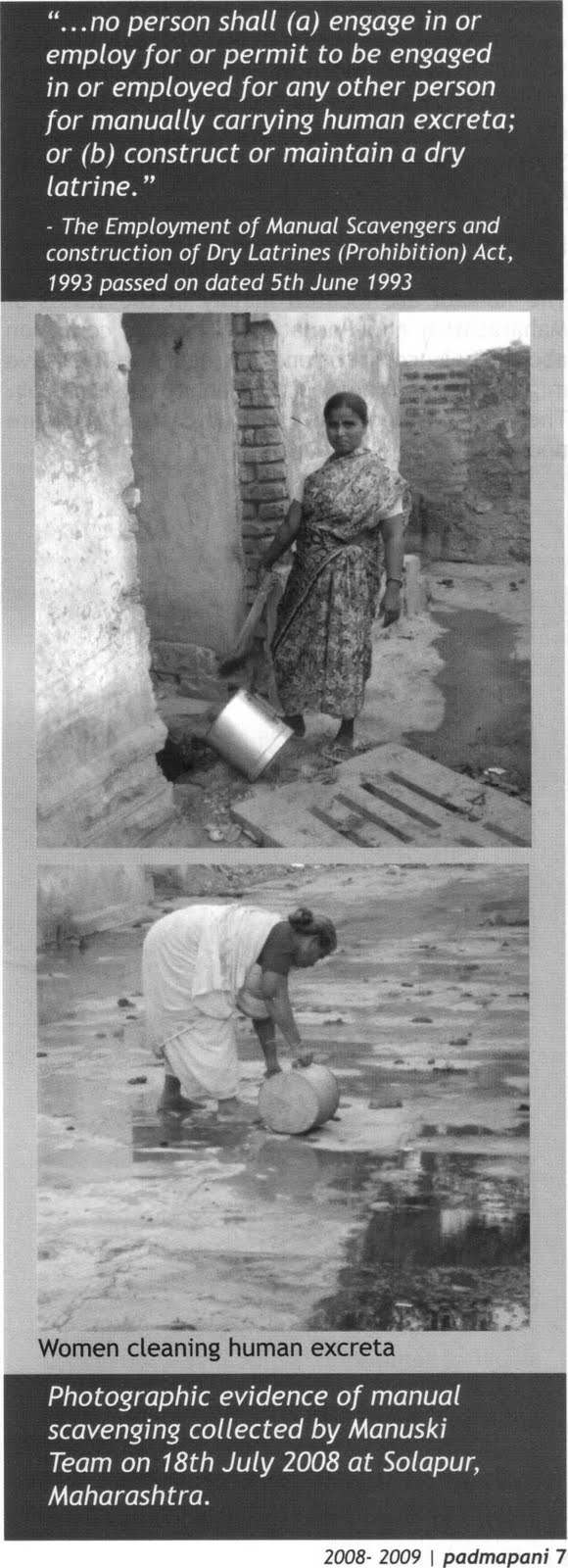
“Dr. Ambedkar urged Dalits in the strongest terms to leave behind their traditional degrading work and live a life of dignity. And yet millions of people born into the Mehetar and other sweeper castes think they are destined to do only this work. Scattered in all the towns in India, they are still obliged to work in the most inhuman conditions and carry human excreta, despite the denials of the administration and government. Indeed the latter maintain this system. They need people to clean all the filth and sewers, and, given the caste-contaminated mindset of most people in India, can only turn to these people. To make sure these people do not try and break out of the caste mould, the government hands out sops like housing and a steady wage to the Mehetar community. But without education, and social support and stimulation, these result in little, if any, progress. [see photo on right]

“Manuski has been producing field reports to bring these denied facts out in the open, and working with other like-minded organisations to campaign to end these inhuman practices. Out of these activities Manuski has been encouraging the development of networks of activists from these exploited communities who can take this forward. At the same time it has continued to develop Its advocacy work with regard to the frequent atrocities these people are subjected to. Finally Manuski has been supporting the emergence of a strong network of Dalit women leaders, activists, educators and social workers in Maharashtra which has now developed its own momentum'.

“While our approach in social work is entirely secular, most of the Jambudvipa and Manuski team have become Buddhists, inspired by Dr. Ambedkar, who realised that only a complete change in mindset or attitude will bring about the social change required to destroy the extremely deep roots of caste and untouchability. To this end Jambudvipa works with the Nagarjuna Institute, TBMSG and other similarly inspired Buddhist organisations to teach people how Buddhist practice can bring about the transformation of mental attitudes. In March 2009 a three day retreat was held in Tamil Nadu, organised jointly by Jambudvipa and the Nagarjuna Institute. It was attended by members of the three most exploited Scheduled Castes in Tamil Nadu - quite an achievement in itself in that, as stated above, people from different castes rarely co-operate. The enthusiasm and determination of the participants to leave behind the shackles of their old designation and all that goes with it, is developing all over the country.

“India is entering into a period of the deepest and most extensive social transformation it has ever experienced, and we feel proud to be able to contribute to this. In the following pages you will be able to see some of the work we are engaged in to this effect. We would like to take this opportunity to appreciate all the support we get from all those who in one way or another have helped to make this contribution possible.

“Lokamitra
“Founder President, Jambudvipa Trust”

For more information check their website www.jambudvipa.org.

 In the UK, the FWBO’s Karuna Trust fundraises to support many TBMSG projects - you can contribute financially or by taking part in an appeal. It’s a great way to get your Dharma practice off the cushion and out into the world!

Labels: , , , ,

Sunday, October 04, 2009

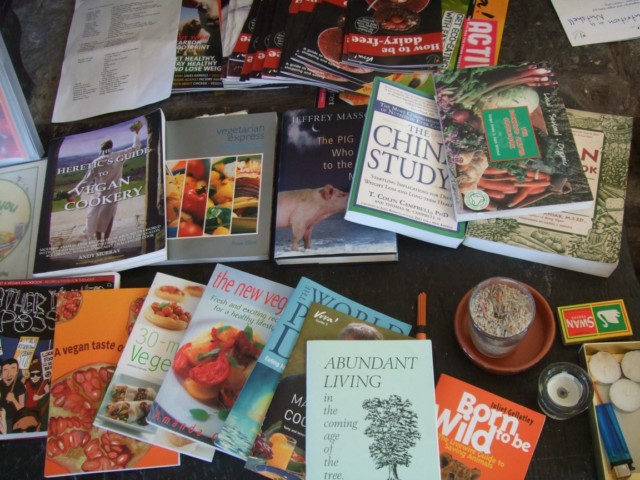
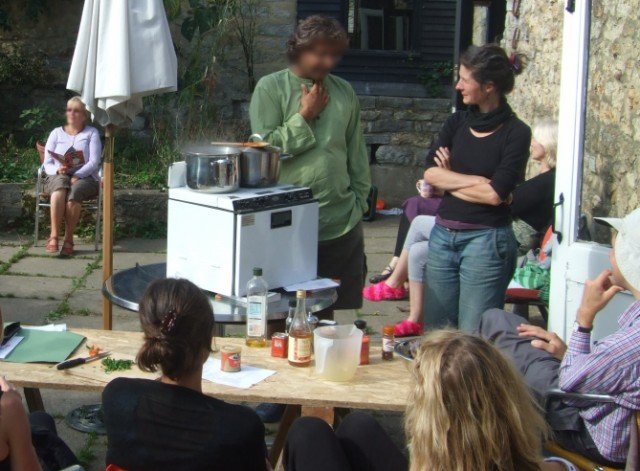
Second helpings at Bristol's 'Compassion in the Kitchen' project

Jane Easton from the FWBO’s Bristol Buddhist Centre writes to say -

“We just had our 2nd "Compassion in the Kitchen" ethical eating retreat, led by Achintya and myself, and thought readers of FWBO News would be interested.

"Last year saw our first vegan cooking retreat ‘seasoned with Buddhist meditation and study’, and the second in the series was equally successful. Run by Jane and Achintya in a way that challenged preconceptions but didn’t moralise, we had huge fun. Everyone left with new skills and recipes as well as information about the issues.

"We hope to take the idea forward next year, so watch this space and keep an eye on our website www.compassion-in-the-kitchen.org.uk".

Jane Easton is a mitra at the Bristol Buddhist Centre and South Bristol Meditation Group, who works as Food and Cookery Consultant for Viva! and the Vegetarian Foundation. She has a wide experience of cooking and writing about vegan food.

Achintya has been a Buddhist since 1980 and was ordained into the Western Buddhist Order in 2000. He teaches at the South Bristol Meditation group. He is also a practicing Counsellor. Achintya has studied Mindfulness with Bangor University and is involved in Non-Violent Communication (NVC) training events across the UK.

Labels: , ,