Friday, May 27, 2011

India and Sri Lanka exchange Dharma teachers

Ujukarin, from Sri Lanka
Prajnajit, from India
Ujukarin, a Dutch Order Member who’s a regular visitor and Dharma teacher in Sri Lanka, writes with news of an ongoing India - Sri Lanka collaboration. He says - “Some years back myself and my friend Prajnajit from India made a vow: we each would spend 25% of our annual Dharmaduta (Dharma teaching) time to assist one another in the neighbouring country. Prajnajit did his part during three months in Autumn 2009, which was described in detail in this blog http://fwbo-news.blogspot.com/2009/09/ujukarin-dutch-order-member-who-is.html . And now, I who am only able to give part-time to my Dharma teaching work, spent 10 days in India to ‘pay back the debt’.

“Our tour was mainly around Umarga town, with a population of 30,000 in the south-eastern tip of Maharashtra state; it has a Bahujan Hitay boys hostel and a Buddhist meeting hall (vihara) in town. Basically what we were aiming to do during my visit was to enhance the regular Dhamma talk schedule of Prajnajit, plus those of visiting Order Members like Abhayabhadra from Pune. We visited two rural towns nearby, the larger city of Osmanabad 100 km to the west and of course Umarga vihara; overall attendance over five nights must have been in the range of 500-700 people. Also during transit in Hyderabad (Andhra Pradesh), 200 km to the east, we had an inspiring evening with the local sangha in their vihara. The talks were successful, and made it on to the pages of at least four local newspapers; the topics we spoke on often linked Buddhism to practical family life in Asia, e.g. parenting, politics, and how to avoid astrology and the dowry system!

Chanting mantras at the start of the Osmanabad event,
with Prajnajit and Ujukarin upfront
“What impressed me most, as well as the usual exemplary hospitality of the Indian Buddhists and the dedication of Order Members and Dhammamitras of course, were the more and more varying circumstances in which we were working, compared to Holland and Sri Lanka. The traditional pattern of oppressed ex-untouchables certainly still exists, as we found for instance in Betjawalaga village close to Umarga. Not only did we need to hold a small ‘procession’ prior to the meeting to demonstrate that all parts of town, including the high-caste ones, weren’t off-limits to the Dalits; we were also told it was better to avoid directly attacking Hindu gods and goddesses in the talk (though this was something Buddha often did) as this could lead to future repercussions on our friends. One very interesting occurrence, on the other hand, was that when we held Triratna day in Umarga we had a smaller audience than we expected. On making enquiries, we found a main reason was that on the same day a popular Hindu temple had held a festival which also attracted quite a few Dalits. That situation sounds positive to me: not so much in terms of ‘more spiritual competition’ but in terms of a new generation of Hindu temples starting to arise which don’t care anymore about the caste of a visitor, or even whether they call themselves Hindu at all!

“Overall it was a very inspiring trip; the Umarga sangha hopes for many more volunteer visitors from the West, whether Order Members or groups of mitras!'

Labels: , ,

Tuesday, May 03, 2011

“Lankan Awakenings”

Ujukarin, an Order Member from Amsterdam but with family links in Sri Lanka, writes with news of developments in the Triratna Sangha there following his recent twice-yearly visit. He says -

"The Triratna sangha in the tropical island of Sri Lanka might be tiny for a country having millions of people calling themselves Buddhist, but it does remain lively - something I've just encountered again following my recent visit.

"Over a week late March Saddhavira, Supadma (visiting from Wardha, India) and myself held a series of meetings and talks around our base in central Colombo and Dhammamitra Renuka’s hospitable South Ceylon guesthouse in Unuwatuna - right on the beach! For about the first time I used a non-Triratna book as basis for the study: the excellent One Dharma by Joseph Goldstein, which I find a good example of unified ‘Ekayana’ Buddhism now also becoming popular outside Triratna. In Colombo we attracted a total of 15-20 people over the three days we were there, whilst in Unuwatuna we saw a few each night and no less than 20 for the day retreat – a record in recent times!

"The reason for this deserves some special attention, as it may also serve as a guideline for other outposts and an invitation for any Triratna community member who wants to help spread the Dharma. Back in Winter 2010 we had already had a one-month stay by Colchester mitras Anne and Ian, which stimulated quite a few local people (esp. women) between Galle and Matara to become more active. This winter these two small heroes, both semi-retired, made it to the island for a full three months. During their time with us they simply kept in close contact with Saddhavira, and decided to run a weekly Saturday meditation morning class; a discipline which normally, due to Saddhavira’s semi-nomadic lifestyle, is hard to sustain. And it worked! - their attendance grew from 2-3 to 5-10 people every Saturday, and culminated with our ‘huge’ day retreat late March. Now Saddhavira has a stable basis to build upon, and we’re looking forward already to the next visit of these and maybe other foreign mitras!"

The photo shows the Unuwatuna day retreat, with Anne and Ian in the back row next to Ujukarin. More photos are on Facebook here.

Labels: ,

Saturday, April 02, 2011

Travels in Orissa, birthplace of the first Dhamma Revolution

Shakyajata writes with news of her recent expedition to Orissa, in the remote north-east of India, where she’s been meeting graduates from Nagaloka, Triratna’s Buddhist social work training institute in central India, and exploring with them opportunities for livelihood and activism. She says -

“In January of this year, Priyadaka, Helen Sullivan, and I travelled to Odisha (Orissa, recently renamed) in the company of Trinath, and Utpal and Nagavajra. The last mentioned are three impressive young Orissan dhammamitras, who arranged our tour and guided and cared for us with great efficiency.

“We did many things there; meetings for mitras and young people to discuss livelihood opportunites; Dhamma programmes; swimming in the Bay of Bengal at sunrise; visiting remote and ancient villages; and visiting a number of fascinating Buddhist archaeological sites.

“ Orissa is actually one most 'fundamentalist' states in India, where foreigners are regarded with suspicion, as mlechhas or Untouchables, and our young Buddhist friends put themselves in danger of violence by being public about their religion. It was very stirring to see the evidence that once it was so different, over a huge area that may even have reached the shores of the Sea of Galilee, 250 years before the birth of Christ. I have heard Indian Buddhist friends talk of the influence of Buddhism on Christianity, and been rather dismissive of this 'wishful thinking', but having seen the evidence of Ashoka's influence, I am not so sure.

“Orissa is full of paradoxes. Despite the reserve of some of the locals, it is a lovely place to visit, with a beautiful coastline and nature reserves; a delightful climate, in January the days warm and balmy, the nights fresh and cool; an amazing cultural heritage, especially of dance; a thriving tradition of skilled stone-carving; the countryside mostly lush and unspoiled, not (yet!) devastated by industrialisation. The Buddhist sites have some wonderful things; huge drum stupas skilfully carved from curving blocks, without mortar, fitting perfectly together; a broken fragment on the ground with a perfectly clear frieze of vajras; the Vajrayana was here! Exquisite Mahayana carvings of bodhisattvas, often damaged, to the grief of our young Buddhist friends; heads of Buddha statues which must have been of colossal size.....so much to see.

“We hope to help these very idealistic young people to set up a livelihood in tourism and pilgrimage, to support their Dhamma work. For more information, see www.justgiving.com/youngindianfutures ... and consider coming to Orissa!

“To give you a flavour of what you might find if you did come, for me, the most stunning sight was at Dhauli, where there stands a modest monument, virtually unknown, marking the spot where the Buddhist Emperor Ashoka began the revolution of peace that was to spread throughout India, into (modern) Pakistan and Afghanistan and beyond. Here there took place the terrible massacre of the Kalingas, a sight of such dreadful carnage and suffering, that witnessing it, Ashoka resolved to abandon his career of kingly conquest and embrace the teachings of the Buddha - to rule his huge empire as a Dhammaraja, a compassionate monarch.

“There is a huge white marble 'Peace Pagoda' at Dhauli, built recently by Nichiren Buddhists, which can be seen for miles around, and is a popular picnic spot. The day we visited, it was pretty busy! But even Hindu 'pujaris' (priests who are fond of telling Buddhists how to worship at their own monuments, for a fee) and crowds of people taking snaps of each other, could not distract from the peaceful sunset view of the river Daya among its green fields; the river said to have run red with the blood of the piled corpses of the Kalingas, in those terrible days. There are many carved plaques on the pagoda. An especially moving one appeared to depict a man in aristocratic dress, gazing in horror at corpses lying on the ground, with other people being taken into captivity; surely Ashoka at his 'moment of truth.'

“Tucked away at a little distance from the Pagoda however, is something even more impressive. A huge rock, bearing eleven of the fourteen Edicts of Ashoka, with an excellent translation, shows clearly the way that his peaceful and compassionate reign was established. In summary, the first 3 Edicts are 'Prohibited killing of animals in the royal kitchen' ; 'Arrangements were made for medical treatment and the provision of medicinal herbs throughout his dominion'; 'Ordered his officials to set out on tour every five years, to propagate moral codes throughout his kingdom' and so on.

On top of the Rock, an beautifully carved elephant is cut from the stone, emerging from it, which represents the Buddha. Amazingly, the Rock Edicts and the elephant are in beautiful condition, not defaced or neglected as so often happens in Hindu India, where non-Hindu history is often crudely assimilated.

“With metta, Shakyajata”

Shakyajata’s fundraising website is at www.justgiving.com/youngindianfutures

Labels: , ,

Tuesday, March 01, 2011

Two new Triratna groups launch in UK

News has just come in of two new Triratna Buddhist groups starting, in Totnes (Devon, UK), and Barry (outside Cardiff, Wales).  They’ll be led by Harry Burgess, Nissoka and Katie (in Totnes) and Sagaradana (in Barry).  Totnes' new website is at www.totnesbuddhistcommunity.wordpress.com; Barry's is still in development but will be at www.barrymeditationcentre.co.uk

The first Totnes class Meditation and Buddhism class is this Wednesday March 2nd, , from 7.30 – 9.15 at the Quaker Meeting House, and Harry says "it's totally free!"  In Barry they start on Thursday March 31st - check their website for more details. 

Sadhu!

The image shows all current UK Triratna groups - click to go to the interactive Google map.

Meanwhile the UK Buddhist world is gearing up for next month’s UK Census, which will include the optional question “What is your religion?”  The UK’s Network of Buddhist Organisations (NBO) estimates there could be as many as 500,000 Buddhists in the UK - and recently mailed out campaign posters to over 1,000 UK Buddhist groups!  More on this tomorrow.

Labels: , , ,

Monday, February 28, 2011

Adventures in Orissa

Shakyajata, well known to readers of Triratna News as an intrepid traveller, fundraiser and organiser, writes with news of her latest adventures - in Orissa, far north-eastern India, where there are a number of small Triratna groups run by graduates of the Nagaloka training institute in Nagpur. She says -

“Orissa (now Odisha, more in line with the way it is pronounced) is an extraordinary place. We were there for 12 days in January. It’s very old-fashioned and underdeveloped, and quite a stronghold of Hinduism, with many famous temples. It is the first place in India in which I have felt like a mleccha, an outcaste from across the Black Water (i.e. outside India) whose touch pollutes; people seemed actually a bit afraid of contact with us; apart from our 'own people' of course, who were overjoyed to see us. They are would-be Buddhists or political followers of Dr Ambedkar, great leader of the Scheduled Castes, now known as Dalits (oppressed people.)

“At one point we visited a remote village and had a meal with the local group, and they were so delighted that they came to meet us with traditional instruments and dancing, and processed us through the village. They had never seen a white person before, except on TV...it was like going back 1000 years into India's history - until our hostess, sister of one of our friends there, pulled a mobile phone out of her blouse! They were so hospitable and kind, and Helen, who is rather Indian-looking apart from her colouring, was a great hit with the younger women (and men!) especially.

“In another village, we were treated to a programme of traditional dancing by young people, women and men. It was terrific - wild and energetic and beautifully done, with costumes just like the ones we had viewed earlier in the State Museum at Bhubaneshwar, great chunky barbaric-looking jewellery and short skirts to free the dancers' strong and lively legs. So different from the traditional Hindu image of women, demure and retiring!

“The museum is very good indeed, with lots of Buddhist stuff and excellent displays of the way of life of 'tribal' people; again we were given some amazing insights by Trinath, who comes from a similar background. His descriptions of instruments were especially good, through them I recognised the ones in the villages, later.

“There is loads more to say about Odisha, but I am running out of time. Today may be the last time I can get on the internet before going to Chhattisgarh, where I am attending a big retreat run by Saddharaja. So this is a sort of half-blog, with a second instalment to follow, after which I will be back to chilly England - but at least the air may be fresh!

best wishes
Shakyajata

Labels: ,

Wednesday, February 09, 2011

New Triratna group takes off in Lewes, Sussex

Akasati writes with news of a booming new Triratna group in Lewes, Sussex. She says - “In November 2009 Sraddhadipa, Dharmavajra and I moved to Lewes, a lively county town 7 miles out of Brighton. Towards the end of 2010, together with Amodana and Don Watts, I set about organising a local meditation course.

“We found a spacious room run by a local health clinic, Dharmavajra made us a poster featuring a Lewes scene and we sent the word out. Buddhafield kindly loaned a couple of large sacks of cushions, blocks and blankets. We were ready to go. We were concerned that maybe the room we were taking on was too big and too expensive - what if we only got a handful of bookings and ended up and saddled with the bill?

“A trickle of bookings started to roll in and I breathed a sigh of relief, confident that we'd be able to cover costs. Over December the booking list grew, hitting 20 towards the end of the month. Sraddhadipa said she'd like to be involved too, making the idea of a large group seem a lot more manageable. Over the New Year period not a day went past when there wasn't an email, a phone call or a booking dropping onto our doormat, peaking with a flurry of last minute interest. Including our team of 4, there are now 33 of us on the course - quite a crowd! There's a good spread of ages and around a third of them are newcomers. Many are people who've already learned to meditate and are looking for the ongoing support of a local sangha.

“We needn't have worried about money. In fact we have enough to set up our group with our own cushions, blocks and blankets, ready for when we need to return the Buddhafield gear in a month or two. We've brought a big rupa with a beautiful face from Evolution and a flip chart stand. It's felt a bit like setting up a mini centre. And I'm in a position to cover the room hire for the next 6 weeks - a continuation course.

“Watch this space!”

Akasati

Labels: ,

Saturday, December 18, 2010

Young People on FBA

Free Buddhist Audio
Spreading the Dharma
Sharing our Practice
Connecting our Community Worldwide


Idealism - strong, radical, humane - doesn't belong to the past. It keeps being reborn, and it is blossoming online. Free Buddhist Audio is there as participant and documentarian in an energized, inspired community working across generations to cultivate change.

You'll likely know Free Buddhist Audio as a webspace for Triratna centres and projects around the world to share their working out of the Buddha's teachings. Free Buddhist Audio is the modern equivalent of the foundational oral tradition - a lively, user-friendly webspace where our community can share our inspirations, our understanding of the Dharma, and our Dharma work, in creative and evolving ways.

In October, the Young Persons Group in Cambridge, England organized a Padmsambhava Day celebration for the sangha and wider community. A series of Dharma talks were given on the theme of Taming the Demons of the Modern World, which have been uploaded to Cambridge Buddhist Centre's page on Free Buddhist Audio's Community Places. Viriyalila, promotions and fundraising team member of Free Buddhist Audio, was inspired to conduct an interview with one of the organizers of the event, Arthasiddhi, who works at Windhorse Evolution, a long standing Triratna (FWBO) Right Livelihood business.

Arthasiddhi explained that a team of five volunteers had organized the event, along with a series of outdoor talks and public meditations. The group's vision was to try "to get out there in our local community and meet people who had aspirations towards making the world a better place." In the spirit of Padmasambhava's legacy, they themed the day Taming the Demons of the Modern World and had planned to give a series of talks on Jesus Green near the city centre, but the weather was slightly uncooperative for that, so this was moved to the Cambridge Buddhist Centre. The Young People's team envisioned connecting with the wider community and had the slightly mad idea to create a papier-mache globe, four-feet in diameter, which they rolled through the streets, asking people to write on the globe what they thought they could do to Change the World. The team and participants were really energized by this, bringing a creative and playful expression of their Dharma practice into the world around them.

One of the talks given at this event, The Demon of Choice, by Aryadhara, has been released as a podcast through iTunes. If you are not already a subscriber, consider joining the Free Buddhist Audio podcast.

What follows is the interview that Viriyalila conducted with Arthasiddhi, exploring why he is active in organizing Young People's events in the sangha. The Free Buddhist Audio team is hard at work actively creating webspaces to support this sort of cross-cultural, cross-generational, cross-continent sharing of our lives, our practices, our aspirations, and our Dharma work. Please consider a donation to Dharmachakra/Free Buddhist Audio today so that we may continue to develop interactive and supportive webspaces, as well as provide free access to Dharma talks for people all over the world.

Young People and the Dharma... An Interview with Arthasiddhi from Windhorse Evolution

Viriyalila: Why is it important to you to have a specific Dharma voice, as it were, for Young People in the sangha?

Arthasiddhi: Initially, as of just a few years ago, I was a bit cold to the idea of talking about Young People's Sangha activities - but over the last year or so I've come to realize that retreats specifically for people under 30 have been instrumental for creating a context that I, and others, have found deeply inspiring. These, initated by Lokabhandhu in Birmingham and then Sheffield, have absolutely sold me and others on the the idea of Young People's Sangha activities.

My personal inspiration revolves around idealism - I want to hear the Dharma being communicated in an uncompromising and authentic way, and I think this is what young people want to hear as well - an uncompromising, idealistic, energetic and inspired exposition of the Dharma. We want to see and hear people who are passionate about what they are doing.

Young people are in a different phase of life. Teenagers are just starting to experience a sense of individuation and are taking in the world around them and coming to their own assessment of what life is about. It is easy to look around us and experience so much disappointment at the lack of awareness, the lack of empathy, the lack of kindness, lack of meaning - coming into contact with an idealistic community can have a big impact on individuals in this phase of life. To meet people engaging with their ideals in a very real way through talks and by example is very encouraging for youthful idealists.

Viriyalila: What do you think inspires younger people to commit more deeply to the spiritual life?

Arthasiddhi: It's really important not to squash people's idealism, the question is how to respond to it. Folks in their 40s and 50s have gained a lot of life experience, partly through making mistakes, and perhaps can see the naivety that young people may have inherent in their strong response to idealistic principles. Understandably they may fear watching someone make the same mistakes as they did, or perhaps new ones. Does one respond to the seed of idealism or the weeds around it? Will it help idealism mature to say I wouldn't do that? I guess there are not simple answers here but people obviously need to make some of their own mistakes and they can do this in relation with others who are more mature.

Viriyalila: What do you think young people relate to most in the Dharma or the Three Jewels?

Arthasiddhi: The idea of the New Society, as described by Sangharakshita. It is noticeable that this has not been talked about much until just a couple of years ago and this was the theme that was very alive on the Young People's Retreat. This really struck me on a very deep level. It is understandable that this sort of idealism - Let's change the world! - would appeal to young people. And secondly, the sangha, the importance of friendship - people that can share their idealism and work together on projects. As someone under 30 you can sometimes feel like a lost soul, when you meet other people that share your ideals it can be a real boon and you start to experience some of your own individuality. You can feel a bit like the only person that cares about certain things. There is a real hunger to meet people who share your concerns and your values. It can really encourage young people to put more of themselves on those values through friendship with others.

It is important to have a context where young people can express their energy and inspiration and where they can find ways to connect. It is also important that this is in connection with people who are wiser - and there is plenty of opportunity in the Order to be with The Wise. The way that happens and evolves is important, and looking for ways to connect and share is of great value.


Check out what's happening in our global sangha by visiting Free Buddhist Audio's Community Places!

Free Buddhist Audio needs your support to continue developing webspaces that spread the Dharma and connect our community worldwide.


Join our community! Make a Donation! Get involved!

Labels: , , , ,

Friday, December 17, 2010

Seven Days of FBA

Free Buddhist Audio
Spreading the Dharma
Sharing our Practice
Connecting our Community Worldwide


Free Buddhist Audio has been working hard all year to provide opportunities for people all over the world to receive the gift of the Dharma and connect with the Triratna Buddhist Community. We are pleased to share with you Seven Days of FBA - featuring some personal stories from members of our online community, as well as updates on new features and a celebration of our 2010 milestones. Stay tuned for articles on Young People, Our Host of Volunteers, New Spanish Translations and more!

Seven Days of FBA - New Features

Responding to suggestions received from our online community, our team has been rolling out several new features for our services - a new and improved search engine, for both audio and text, as well as new navigation features that allow talks to be viewed as images or text. The result is A-Zed Dharma at your fingertips!

New & Improved Search Engine

Q. How do you make 17 million words and 1000+ talks easily searchable? A. With a lot of constant effort!

We're happy to introduce here the latest and greatest version of our search engine. It's been re-written to allow more flexible keywords and search items to improve the results given. We hope you'll find it useful!

Located in the upper right corner of the site, a panel appears when you begin typing in your search item. The default search is for audio, but you can also specify 'text' and adjust a few other key things, and then you're off and running. And we'll remember the way you set things for your next search - though it's always easy to change with a simple click!


If you prefer, of course, you can easily do more advanced searches in the text archive (we provide clear, plain English instructions!), which contains all of Sangharakshita's seminars, and is growing with every transcription we receive from our volunteer community. And with this, let's take the opportunity to thank our host of volunteers - your work helps make FBA a more comprehensive service that benefits many beings!

A-Zed Dharma at your Fingertips

We are also very pleased to announce new navigation features we've added to many of the pages within the site. Collections of talks can now be viewed as images or text lists, depending on what you prefer. You can also view the talks alphabetically, chronologically, or even (in relevant places) by date they were uploaded.

Themes sorted alphabetically by images...


Titles sorted alphabetically by text, newest first...


Our team is constantly working to think ahead about the needs of the community - five, ten, fifty years! As our archive grows with each new talk given around the world, we are developing systems to maintain our oral history and keep it flourishing and readily available to all. Modern innovations on the web helps us provide you with better access today and preserve our teachings for many generations to come. Please support us in our efforts!


Labels: , , ,

Monday, November 15, 2010

Jai Bhim group in Kerala plan big retreat

Arun and Rejimon, two mitras from the Triratna Buddhist Community, write from Kerala in South India with news of their upcoming ‘communicative English retreat’ in Kerala - a unique hybrid of English coaching and Buddhist practice. They say -

“Dear friends Jai Bhim!  We are very happy to introduce the second annual communicative English retreat in Kerala led by the Dhammamitras of the Triratna Bauddha Mahasangha Kerala, Southern India.

“Last year we had our first Communicative English Retreat in Kottayam, held on December 23- 27, 2009. It was led by Ann Dennehy from the USA along with Arun, Rejimon, and Jayan Babu, who are graduates of Triratna’s Nagarjuna Training Institute at Nagpur . Ann is the Creative Director of Jai Bhim International, a Triratna not-for-profit based in San Francisco who run many fundraising and awareness-raising events in the USA.

“This year's second annual Communicative English Retreat will be offered on December 24 - 28, 2010 at the Govt High School in Payyanalloor, Adoor, Pattanamthitta district. It will be led by the graduates of Nagarjuna with guidance from Ann. This time we will assure maximum participants of ex-trainees of Kerala.

“Last year 15 selected youth were attended that retreat. Every day was started with meditation and concluded with puja and short meditation. In between for the whole day we were studied communicative English, Ambedkarism and basic Buddhist teaching through English. The speaking practice was conducted through games and informal discussion, it was a very fantastic experience. On the last day of the retreat we had very nice cultural program. It was new experience to our participants; every participants explored their potentialities of English speaking.

“At the end of the retreat we formed a team, which we called “Jai Bhim Kerala”; we chalked out the whole year work plan and we conducted a lot of discussion about Ambedkarism and Buddhism . Now our second annual retreat is conducted by the initiative of Jai Bhim Kerala team. This year we expect 30 girls and 30 boys, slowly Dr Ambedkar ‘s vision is going to spread throughout Kerala
Please join us”.

For more details check their new still-under-construction website www.jaibhimkerala.org; find Jai Bhim International on Facebook, or email arunboudh@gmail.com or rejimonpk@gmail.com.

Labels: , , ,

Monday, October 18, 2010

Subhuti: a report on 2010

Subhuti is one of Triratna’s longest-ordained and most active Order Members. 2010 has been a busy year for him, with activities in the UK, India, and Hungary. Dharmashalin, his secretary and travelling companion, sends this report, telling us some of what he's been up to.  He says -

“Since May last year Subhuti has led four Order meditation retreats; three in India and one in the UK. He’s been leading twice-yearly retreats in India for over ten years, and they perform a vital function in the life of the Indian Order, providing a real opportunity for depth and reflection amidst the busyness and demands of Indian life. In the last year he has been focusing more on meditation; one on the Satipatthana Sutta and one on the System of Meditation. Both retreats have seen high attendances, one with 108 Order members - over a quarter of the male Indian Order. Numbers of course do not preclude depth and I heard several people reporting them to be the deepest retreats they'd ever attended.

“The retreat in the UK had slightly less people, but depth was certainly present, with several saying during the reporting out it had been the most intense retreat they'd been on for years. Again the theme was The System of Meditation and talks are available here on Free Buddhist Audio. This was the first retreat Subhuti has led in the UK since 2002, but we hope it will become an annual event. Whether in India or the UK, these retreats are connected with promoting depth, especially within the Order, and personally this seems to me to be one of the key functions that Subhuti can perform. Obviously the retreat context is best for this, but it can be achieved more widely too.

“In August he attended part of a large retreat for Chairs and others taking organisational responsibility within the Triratna Buddhist Community. Here he spoke on Just Sitting and the Six Elements practise. It seems that Just Sitting particularly has been needing more emphasis within our Order - Bhante had always given it a central place but that seemed to have slipped. In his talk on the subject Subhuti introduced the 'Five Justs' (five ways to approach Just Sitting) and that certainly helped me get clearer about what I'm meant to be doing in this practise.

“Whist in the UK, Subhuti has been spending more time at his home in North Wales, where he hopes to do more writing. In the past year that has mainly consisted of editing and preparing material based on interviews with Bhante. These pieces, now published, cover important areas of Bhante's character and approach to the Dhamma that hopefully will serve as a basis for clarity both for us and those in the future. I also hope to edit some of his spoken material into resources that can be published on-line. They are available on Sangharakshita’s website www.sangharakshita.org .

“Subhuti has been an increasing presence at the London Buddhist Centre, making 3 visits in the last eighteen months. During these visits he has returned to his popular 'Rambles Around...' format, where he gives somewhat open talks with an opportunity for questions. These take place in the early evening – just before the main classes, leading to a somewhat chaotic but spiritually rich traffic jam at change over time! If you'd like to listen to these talks they’re here on FreeBuddhistAudio.  They were given before the publication of 'Revering the Dharma’ and you can see Subhuti developing those ideas through these talks

“Subhuti’s other significant outreach area in Europe is his work in Hungary. A group of Roma (Gypsies) have developed a connection with Dr Ambedkar and become Buddhist. Although the movement there is small and tender, developments are occurring. Some of these mirror our approach to work and teaching in India - for example Subhuti emphasises the importance of personal responsibility as the first implication of karma, and a vital one for members of disadvantaged communities such as the Gypsies. After having a 'conversion ceremony' one young Gypsy was seen exclaiming 'I'm a Buddhist, I'm a Buddhist!' with a sense of pride and self confidence that is an important step in starting to change the basis of his self identity to something more positive.  Their website is at http://Jaibhim.hu

“Back in India, Subhuti has also been doing outreach work. In December we held a Dhammakranti (‘Peaceful Revolution’) retreat in Gulbarga in Karnataka - a new area for us. We had a thousand retreatants for five days and a substantial Order team (shown opposite). It was the usual slightly chaotic mix of talks, meditation, chatting and puja! What seemed most significant for me was the effect we had on the local Bhikkhus in charge of the centre where the retreat took place. At the start of the event we had some difficulties, but by the end they organised a felicitation program where they gave the fourteen Order members present garlands and small gifts. This is significant because our emphasis on Going for Refuge instead of on Bhikkhu ordination is more controversial in India. However, in his concluding speech the head Bhikkhu emphasised the depth and genuineness of the Dhamma which we communicated!

“This work makes a significant contribution to the Sangha both in the West and in India. Thanks to modern technology we are more able than ever to make material taught in either context available to others. Thanks mostly to FreeBuddhistAudio, but also to Videosangha and CD and DVD distribution in India, the Dharma is spread beyond those who attend events that Subhuti leads/ participates in.

Much of Subhuti’s support is raised by personal donations, and I collect donations via a fundraising page on JustGiving - see www.justgiving.com/supportingsubhuti . The money raised here contributes supporting Subhuti's work for the Dharma, spanning both India and the UK.  There's also a Facebook page where you can keep in touch with what we're up to.

Labels: , , ,

Thursday, September 02, 2010

Dharma activities develop in Barcelona

Meditation teaching at la Fira de la Terra  
Rijumati, well known to Triratna News readers for his epic round-the-world travels back in 2008, writes with news of the developing Triratna sangha in Barcelona, Spain. He says -
“I want to let you know how things are progressing with plans to develop Dharma activities in Barcelona and also to ask for your help.

“Currently there is a small group, some of who are strongly committed which has been maintained by Paramachitta and Amalamati over the last two years. Both of them live in Valencia and commute to Barcelona. This group meets weekly in a rented room in the centre of the city just off the famous Ramblas. There are perhaps 6 people who make up the core and another 30 who regularly participate.

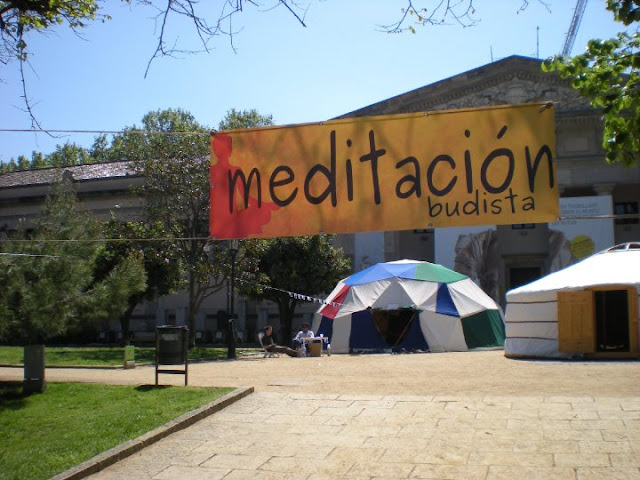
“In April this year a group of us set up Bodhin's geodesic dome at Barcelona's annual alternative fair La Fira de la Terra and we taught over 200 people to meditate in the midst of a huge festival of music, therapy, food and fun in Barcelona's lovely Parc de la Ciutadella. In subsequent weeks the little meditation group was swamped with newcomers. There is clearly lots of potential. The local group are very keen for some Order Members to move to Barcelona.

“Sinhendra and I are planning to move to Barcelona early in 2011 to start a proto-community and start to develop activities further. First off we would establish a regulars group in addition to the beginners drop-in so that we can build more depth with the existing Sangha. We don't think of trying to get a Centre at first, but rather to build up a series of classes all around the different barrios many of which have quite different cultures. Perhaps we would also do an english language dharma class since there are many foreigners living and working in Barcelona. We also intend to set up frequent (perhaps monthly) weekend retreats to help build sangha and because apparently the Catalans love getting away on weekend workshops.

“Once we have a better feel of the city and where we are most effective we may start to look for a building to be a base. Other Order Members are also involved. Nagesvara is planning to arrive in the city once he has qualified as a mental health nurse. Siddhisvari is keen to come and wants to start a Right Livelihood vegetarian café: several people have already said they would like to work with her including Rochini and a mitra in Mexico. There are several other OMs and mitras who may come or are thinking about how they can be involved in coming years.

“Naturally with the Valencia Centre, EcoDharma, Akasavana, Guhyaloka nearby and many Order Members in the region I am very much hoping to get the Order in Spain very involved in the project: Guhyapati, Padmadharini and others may well come and do events in Barcelona from time to time.

“Obviously money is big issue. Barcelona is not a cheap place to live and Sinhendra and I don't want to spend lots of our time slogging away in a dead-end job just to pay the bills. I received a tremendous boost earlier this year when Windhorse trading offered to support me for my first year in Barcelona in exchange for 4 months work as a van salesman this autumn. That takes off the pressure hugely. Sinhendra has been looking for work teaching english in Barca for a few months but the Spanish economy is in dire straits and unemployment is high. It could be hard to get enough work at first, though it also means that rents are low, properties are available (e.g. for a café) and many people have spare time to get involved in something exciting.

“I would particularly like to help Sinhendra get some support so that he is free to do more Dharma work in our first year. Money for expanding activities would also allow us to be more adventurous with new classes, retreats etc. Do you have any idea if we could fundraise for the project in the UK? How should we go about it?

“I hope that gives you a taste of what is going on.
“with metta
“Rijumati

Triratna Barcelona have an on-line fundraising page at www.justgiving.com/triratna-barcelona.
Their events website is at http://budismo-barcelona.com.

Labels: ,

Tuesday, June 15, 2010

Mitra ceremony in Western Ireland

June 3rd saw the three small Triratna Buddhist Sanghas in the West of Ireland coming together to celebrate their fifth mitra ceremony, welcoming Pat Youell from Westport into their number. The Ballina Hotel provided the venue, Sinhaketu - founder and principle teacher for all groups - was the celebrant, and Lokabandhu from the Triratna Development team, who happened to be visiting, managed to video the proceedings.

Watch it in the embedded player below, or click the direct link
www.youtube.com/watch?feature=youtube_gdata&v=cSAfYLWGDzc


Pat joins approximately 10,000 Mitras around the world, including 2,000 in the UK and some 7,000 in India.  Triratna activities in the West of Ireland are held weekly at Belmullet, Ballina, and Westport.

Sadhu!

Labels: ,

Saturday, May 15, 2010

Suvannavira's adventures in Russia

Suvannavira is an Order Member currently exploring the possibilities of establishing himself in Russia and teaching the Dharma there. for the past year or more he’s been visiting regularly, building up contacts and getting a feel for the land and its people.

Now he’s written to Triratna News, saying -

“The moment finally felt right to write a few words about my adventures in Russia.

“Having been born in Russia and having left the Soviet Union as a young child with my mother, maybe it was not surprising that I would be keen to return to re-discover the country of my birth.

“Arriving in St Petersburg for a few days, I plan to stay in Moscow for two months during which one important goal is to continue re-learning Russian which I forgot as a young child on my arrival in England.

“In mid-July, I plan to travel back to the UK overland by train, stopping to visit cities and friends in Kiev, Odessa, Krakow, Berlin and Paris.

“My longer term aim is to establish the teaching of my teacher Bhante Urgyen Sangharakshita in the land of my birth.

“In the meantime here's a photo taken on a sunny day in May around the celebrated Nevsky Prospect, St Petersburg's most famous street and amongst other things, the setting of some of the novels of Gogol.

“With metta,

“Suvannavira

Suvannavira’s keeping a more detailed blog of his travels, which you’ll find at http://suvannavira.blogspot.com. There’s also a very substantial Russian Dharma website, created by Suvannavira, available at http://buddhayana.ru

Labels: ,

Wednesday, May 12, 2010

3rd Anniversary celebrations in Düsseldorf

Sraddhabandhu writes from Düsseldorf in Germany, where for the past three years he's been building up an FWBO/Triratna Sangha there.  They've just celebrated their third anniversary, and he writes to say - 

"At the end of March we celebrated the third anniversary of our centre in Düsseldorf. And unbelievable 30 people turned up, a part of them from Essen.  See our quite full shrine room:

"Apart from our regular “open nights” we now do a meditation day every other month and a Puja each month.  

"And we've been able to widen our Internet presence: we now have our main site, a online Yahoo-Group and a Facebook page. 

"I've even been working on a small website for mobile phones (www.duesseldorf-buddhismus.de/indexmob.html), so that people can have a quick glance on the titles of the talks I give on Mondays. 

"Next for us comes a small theater play we want to do on Wesak - we hope that we are successful! 

"With metta, 

Sraddhabandhu

Labels: ,

Monday, May 03, 2010

Annual Kshitigarbha retreat draws 500 people in Central India

Saddharaja, an Order Member from Cambridge UK, writes with news of one of Triratna’s largest annual events - the Kshitigarbha retreat in Maharastra, central India. The Kshitigarbha project (named after a Bodhisattva of the same name) began as way of reaching some of the many thousand Buddhist agricultural workers in Maharashtra, central India - many of whom were very poor and unable to afford even the most basic retreat fee. Each year a small team from Cambridge UK, fundraise for the necessary money, then travel to India and conduct the retreat itself and a series of Dharma talks in outlying villages. Here’s what he says -

“Vipulakirti, Dharmasiddhi and I arrived at Nagaloka [Triratna’s training centre in Nagpur] on January 13th, and stayed a couple of days. We were joined by Adityabodhi, Shakyajata , Priyadaka and Sujiva - and all headed out to Wardha City by jeep on January 15th for the first day of the 2010 Kshitigarbha retreat. The previous night I’d given a talk at Mahendranagar TBMSG, a poor locality of Nagpur.

“The 5-day Kshitigarbha retreat was held in a large, rented marriage hall in the suburbs of Wardha. A team from TBMSG Wardha – led by Harshavir and Lokanath – found and prepared the venue. Karunashura was there to greet us. As the retreat organiser, he had done so much good work preparing the retreat.

“500+ people attended the 5 day retreat. Back home we’d successfully raised £3959.00 to cover this, plus the cost of a 6-day Dhamma activities tour of Wardha district. Almost all these retreatants would not have been able to afford to attend the 5-day retreat without this dana.
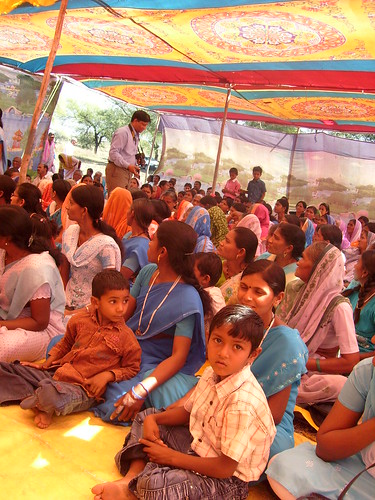
“We had intended that 900+ attend the retreat, and that number had booked. However, in the previous month, Wardha district (one of the hottest parts of India) had experienced almost unprecedented extreme cold weather. Many retreatants fell ill, and had to cancel. This was disappointing, but beyond our control. Thankfully the weather improved just before the retreat started.

“The theme of the retreat was ‘The Threefold Way’ (sila, samadhi, prajna). Vipulakirti, being a Buddhist choir master and mantra-tune composer, had composed a catchy Indian-style tune (‘ seeela, samaaadhi, prajnaaayayaaa……!’) which caught on very quickly and enthusiastically.

“Each day of the retreat, we meditated (having taught the practices to newcomers), listened to a full-length Dhamma talk from myself (excellently translated by the stalwart Adityabodhi), and discussed the talk theme in many groups, led by the various Order members. In the evenings, we had more Dhamma talks, and puja.

“As ever, this Kshitigarbha retreat was suffused with friendship and friendliness, with much chatting and socialising. The dormitories were enormous by Western standards, and the food excellent. We also had a competent mitra team who were essential to the smooth-running of the retreat.

“Towards the end of the retreat, we had a conversion ceremony for an 18-year old ex-Hindu girl. The conversion ceremony and the final puja of the retreat were very moving. On the last morning many men and women were in tears – sorry to leave. They had appreciated the retreat so much. For many, this was their first contact with Buddhism.
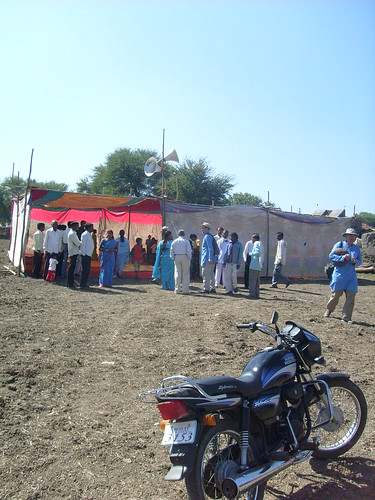
“After the retreat a group of us set out on 6 days touring to Buddhist villages and towns in the Wardha district. We travelled by jeep and motorbike, and covered so many places: Sarul, Dhammangoan, Pusad, Yaratmal, Pulgoan – to name a few. We saw so many beautiful villages and vihars, and most days, had a Day Retreat with many enthusiastic Dhamma practitioners. Day or evening programmes could vary in numbers from 100 to nearly 1000 people. Many tasty meals were eaten, many inspiring Dhamma talks given, and a deep spirit of Sangha pervaded these events, with the chief focuses of inspiration being: The Buddha, Dr Ambedkar and Bhante Sangharakshita.

“For the team, there was great value in this 6 day tour. We had originally planned it for 5 days, but in the end, 6 days was better. We were able to meet and reconnect with many men and women from previous Kshitigarbha retreats, and rejoice in the merits of their continuing Dhamma life, and the excellent follow-up work of local Order members in their locality – who see this work as under the heading of Kshitigarbha work.

“Our final Kshitigarbha event of this tour was in a slum area of Nagpur. We shared this event with a Theravadin Bhikkhu. This final day retreat ended with a jeep ride through the chaotic traffic of Nagpur to catch the Bodh Gaya express train - four of us were about to round off our 2010 Kshitigarbha Dhamma adventure with a week’s pilgrimage at Bodh Gaya, via Varanasi. Karunashura stayed on in India for a few more months – continuing on with more heroic Dhamma work.
“‘Kshitigarbha’ as a project name is evolving and developing in the Indian Sangha, and may become a group of Dhamma activities and even charities, of which, the Kshitigarbha dana retreats may just be one aspect.

“For next year, there is a tentative plan to have two Kshitigarbha retreats – one in Wardha again and also another a week later in Aurangabad.

“I’ll finish this report by thanking all our generous donors – wherever you are. Your dana makes a big difference. Our website is at www.justgiving.com/kshitigarbha if you'd like to contribute to our next one”.

Saddharaja

Labels: ,

Wednesday, April 14, 2010

Subhuti and Vidyaruci in Hungary

Vidyaruci, an Order Member based in Birmingham UK, who currently works as Sangharakshita’s secretary, writes to say -

“In the last week of January I accompanied Subhuti to Hungary to visit our friends from the gypsy Buddhist community, with whom Subhuti has been in contact for some five or six years. It was my fourth trip to Hungary, and I was very glad to see my friends there, especially Janosh and Tibor, who form the core of the Jai Bhim Network, a small, but growing, Buddhist organisation, which takes as its inspiration Dr Ambedkar’s vision of social change through the practise and propagation of the Dhamma. From the Dr Ambedkar High School in Northern Hungary, where we stayed, Subhuti met with students and teachers from that school and others nearby, and taught them about Buddhism and Dr Ambedkar.

Members of the Jai Bhim network in Hungary
“Hungary is a deeply divided country. The gypsies are the largest minority in the population, and are subject to widespread prejudice and discrimination. Though I had learned this much, and seen evidence of it, on previous visits, there was one particular incident on this trip which brought this home with particular force. In recent years there has been a worrying growth in the popularity of an extreme right wing political party, which is explicitly racist, known as Yobbik. Yobbik had recently been campaigning in a town near to Sojokaza, where the Dr Ambedkar High School is situated, and there had been trouble between gypsies and Yobbik thugs, resulting in the arrest of some gypsies.

"While we were there it transpired that Yobbik were planning to come to Sojokaza. Understandably the gypsies were very worried, even frightened. A meeting was arranged between the gypsy community and the mayor of Sojakaza and police chief, which Subhuti and I were able to attend. The tension and fear in the room was palpable while the anxious looking mayor told the gypsies that Yobbik were a legal political party exercising their democratic rights, and that there was to be no trouble from the gypsies. Though clearly frightened, the gypsies generally expressed themselves with admirable restraint, which may in part be due to the influence of the Jai Bhim Network, and the sense of empowerment that it has given them.

“One example of this is empowerment is the ‘women’s sangha’, which is a group of gypsy women who have weekly meetings to try to find solutions to some of their difficulties. We were able to attend one such meeting, which included what was in many ways the highlight of the trip, which was a ceremony to mark the conversion to Buddhism of one of the young gypsy boys. ‘Cubu’, as he is nicknamed, has been a presence on each of my trips to Hungary, and it was a real pleasure to see this delightful young man make his first formal commitment to the practise of the Dhamma, and to see the positive pride it gave him afterwards to repeatedly state ‘I am a Buddhist!’.

“I feel greatly privileged to be able to witness the activities of the Jai Bhim network in Hungary. Tibor and Janosh, and all those dedicated to the same cause, deserve our admiration and support.”

Vidyaruci

For more information check their website www.jaibhim.hu

Labels: ,

Tuesday, February 09, 2010

International Buddhist Youth Exchange program in Malaysia

Today’s story on FWBO News comes from India’s National Network of Buddhist Youth (NNBY) - just back from participating in the 2010 International Buddhist Youth Exchange program, held in Malaysia.

Chetan Meshram from Nagpur, central India, attended along with Vasitkumar from Pune. They say-

“Last week we have been in the Asean Youth Exchange at Malaysia. The WORLD FELLOWSHIP OF BUDDHIST YOUTH  (WFBY) organized the ASEAN INTERNATIONAL BUDDHIST YOUTH EXCHANGE (IBYE) 2010 which was hosted by the YOUNG BUDDHIST ASSOCIATION OF MALAYSIA (YBAM).

"We were representing the National Network of Buddhist Youth (NNBY) from India. Other countries which participated included Bangladesh, Indonesia, Nepal, Japan, Taiwan, Thailand, Malaysia, and South Korea.

"The main object of the programme was to promote development of leadership qualities among Buddhist Youth and also to strengthen Buddhist Networking across South East Asia.  The program was held in the Fo Guang Shan monastery. The theme of the event was “Joy, Fellowship and friendship.

"The 10 day programme was divided into four parts:

1) Home Stay Program
"International delegates were staying with Buddhist foster families for the first three days of the programme. Coinciding with the New Year and weekends, they had the opportunity to start 2010 in Malaysia, and also to feel and experience Malaysian lifestyle of living culture, food, sights and sound.

2) ASEAN IBYE leadership and Training Workshops:
"A series of sessions catering for the learning, contributing and tackling of current situations faced among youths in the Buddhist society, both local and international.

3) Malacca and Kuala Lumpur tour
4) ASEAN IBYE JFL Concert 2010

"We were able to make the other delegates aware about the concerns of Buddhist youth in India. Their social, economic and educational situations were discussed. Most importantly we communicated the revival of Buddhism and dynamics of Dr. Babasaheb Ambedkar’s movement. We both explained the aims, objectives, and mission of NNBY - www.nnby.org

"The event created strong connections between those who attended. We hope these connections will contribute to the betterment of the youths in ASEAN and especially more widely in India.

"For more information and picture follow ASEAN IBYE 2010 in facebook.

"Thanking you".

Labels: , ,

Thursday, February 04, 2010

Copenhagen hosts joint first Danish-Swedish day retreat

Advayasiddhi writes from the FWBO’s small Danish Sangha with news of the first joint Danish -Swedish day retreat. She says -

“This Sunday saw the first event for people from both sides of Øresund - the small stretch of sea that divides Denmark and Southern Sweden. The day was held in Copenhagen where the (very small) Danish Sangha had invited people from Skåne to come and join them for a day of practice.

“Even if the numbers ended up low, the quality was high and we had a great day led by Advayasiddhi, meditating together and talking about the three jewels and about how we are part of a long lineage and a much bigger community.

"We ended the day with a small ritual offering our aspirations to the Buddha and sharing our merits with all beings.

“We hope to do another day soon, so let us know if you want to join”.

Check their Facebook group Buddhistisk Meditation to stay in touch.  There’s a more general introduction to Buddhism and meditation in Danish on their website www.buddhistmeditation.dk

Labels: , ,

Wednesday, January 13, 2010

Finding 10,000 rupees in Poland - an update from Sanghaloka

Two years ago Nityabandhu and others set up Sanghaloka, a new FWBO centre in Poland. Now he writes to tell us what it's like running it on a day-to-day basis...

He says -

“Rather than bore you with details of day-to-day events at Sanghaloka in Krakow I thought I'd tell you how it is for me to be running this place (with Sassirika, Santaka and others of course).

“It’s like finding a large banknote on the street (say 50 pounds, or 100 euro or 10,000 rupees). Suddenly one feels strangely and unexpectedly fortunate - owning a little fortune. The difference is that with Sanghaloka I feel like that almost daily.

“The greatest pleasure is meeting the people that come and getting to know those that stay and come regularly. Sometimes I don't feel like doing the admin or updating the website, or even teaching meditation or co-leading courses with Santaka. But once I start these things are so incredibly rewarding that it does feel like finding whole bags of money on the street.

“I can't think of doing anything better with my life - I can only think how to do better what I - what we here - are already doing.

“Nityabandhu

The Sanghaloka website, www.buddyzm.info.pl is actually a substantial Polish Dharma resource - and there’s more, on meditation, on the Polish edition of the Wildmind site, polski.wildmind.org.

The photographs are from recent Sanghaloka retreats in Poland.  Nityabandhu is in the centre of the top photo.

Sadhu! - and “Przyjaciele Zachodniej Wspólnoty Buddyjskiej” (as they say in Krakov!)


Labels: ,

Wednesday, December 23, 2009

Subhuti in India December 2009

Following yesterday’s report of Shakyajata’s Indian travels and Dhamma work, today FWBO News brings you an update on another Order Member's work there. Subhuti is one of the Order’s most active Dharma teachers; he is currently in India on a six-month teaching visit, criss-crossing it North South East and West... FWBO News has recently stumbled across his Facebook page and brings you a digest of some of the stories there.

They’re posted on the FWBO Features page at www.fwbo-news.org/features/SB_Facebook_09d: click to read...

For more news of Subhuti, we’d recommend you become a ‘fan’ of his Facebook page www.facebook.com/pages/Dharmachari-Subhuti

The reports were written by Dharmashalin, Subhuti’s secretary and travelling companion.

Labels: , ,